HOW TO LAY NATURAL STONE PAVING
Category: Landscaping
Published: 06/10/2022
How to Lay Natural Stone Paving
A good plan is essential to completing a successful paving project. Adequate falls for drainage is required if you want it to be safe and durable. If in doubt, check with your local utilities company before starting any construction to ensure that you do not accidentally strike or obtrude any cables or pipes.
Outline the project area and excavate the installation area. Projects that will be exposed to only foot traffic generally require 100 -150mm of crushed stone Type 1 MOT, while driveways or projects in very wet soil may need as much as 200mm of base. Be sure to excavate 150 to 200mm beyond the boundaries of the project to give you ample space to install your edge restraints.

The best way to lay stone paving
Lay a suitable sub base such as Type 1 MOT and be sure to lay base material beyond the planned boundaries of the paving stones. Laying the base outside the boundaries of the pavers will make your project more stable. Make sure this is well compacted using the necessary equipment such as compaction plate.
After the sub base is compacted, use a wet bed of mortar 6:1 ratio and ensure you achieve 35 to 50mm laying course of mortar mix. All natural stone should be laid on a full bed of Mortar that supports the whole flagstone. Use of a priming slurry Should be applied to the underside of the paving stones to help improve adhesion. (Spot bedding on any paving stone is not recommended). Ensure all cement stains are washed off immediately or this would result in staining the slabs. Do not use acid based cleaners for removing stains.
Paving stones should be carefully laid on top of the mortar mix, tap into place using rubber mallet. Place the next flag with an adequate joint and continue with appropriate laying guide. After completion of laying the flagstones, curing time should be allowed for 24 hours.

Can you lay sandstone on sand?
There is much discussion on this subject but the short answer has to be no. Laying stone paving should only be done with a full wet bed of Mortar at a ratio of 5.1 sand and cement and the slabs should be primed individually before laying using a slurry primer to aid with adhesion and to prevent salt blooms.
How do you point stone paving?
Pointing is one of the last and most important stages of getting your patio looking right, and finished properly.
There are a few options with pointing/jointing, here we will look at traditional method of sand and cement, as well as brush in ready made jointing products. Sand and cement pointing is undertaken after the laying paving stone and given time to dry (normally 24-48 hours) and must be done in dry, frost free conditions of 2 degrees and rising as a minimum, to allow the pointing mortar adequate time to dry and harden.
The first stage is to make sure all gaps to be pointed are dry and clean, and then the mortar can be mixed. An average ratio of sand to cement would be 5 parts sand to 1 part cement, you can go stronger than this however weaker is not advisable. Mix the sand and cement together adding a small amount of water to the correct consistency. This should be able to ball up in your hand without crumbling and not to wet, now you can start pointing your patio.
.png)
Can you jet wash sandstone paving?
A jet washer or pressure washer is an ideal way of cleaning sandstone paving, but care must be taken. It is important to use either a flat surface cleaner or a wide fan tip. Some sandstone can be soft it is important not to use a pencil jet or use a turbo on a high pressure setting directly on to the sandstone at close range however you can use pencil/ high setting if you keep the pressure washer held above the paving around 300 mm.
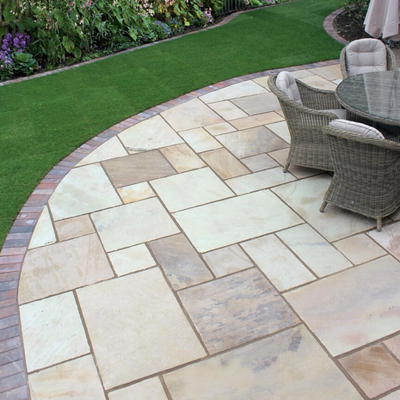
IBT have some Out of this World deals on Natural Stone Paving (single sizes and project packs).
www.ibtmerchants.co.uk/category/83/natural-stone-paving/all